
September 2026 is unusually dense for frontier-model releases: multiple major vendors changed the comparison set within eight days. That timing creates a practical problem for engineering and product teams. Which claims are confirmed product facts, which are only leaderboard signals, and which differences will change a deployment decision?
The cycle includes Anthropic’s Claude Opus 5.5 and faster, cheaper Claude Sonnet 5.5, OpenAI’s GPT-6 listings alongside limited benchmark evidence, and Google’s announced but restricted Gemini 4 Argon. These are not equivalent events, and treating them as such produces bad procurement decisions.
The useful approach is to separate positioning, measured results, and actual access. We’ll map the September timeline, identify what each release establishes, then turn those distinctions into a workload-based evaluation framework covering quality, latency, cost, reliability, governance, and rollback—not just leaderboard rank.
A compact September timeline
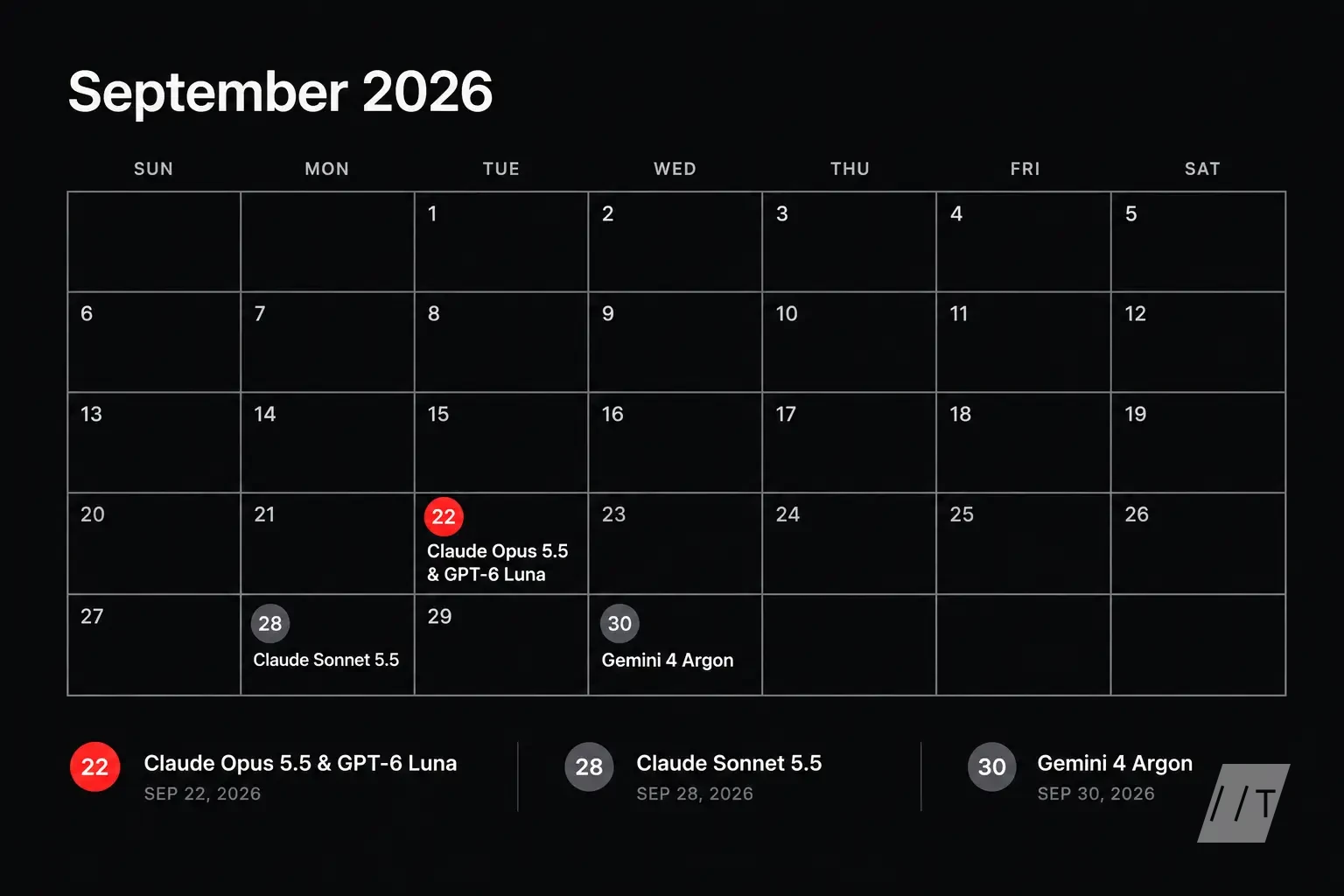
September’s sequence is easy to misread because the dates represent different kinds of evidence.
- September 22 — release listings: Claude Opus 5.5 and GPT-6 Luna appeared in a model-release listing. That records a named release entry; it does not, by itself, establish broad API access, production readiness, or a complete product launch.
- September 28 — formal announcement: Anthropic announced Claude Sonnet 5.5 as the second model in the Claude 5.5 family. The announcement describes it as faster and cheaper than Sonnet 5, but an announcement still needs to be translated into the access, limits, and reliability available to a given deployment.
- September 30 — formal announcement with limited rollout: Google announced Gemini 4 Argon, describing frontier performance across software engineering, enterprise knowledge work, and cybersecurity. Access was rolling out to a set of trusted cyber defenders through the stated program, so this was not equivalent to general availability.
The useful distinction is operational: a listing tells you a model has been recorded, a product announcement explains the vendor’s positioning, and a limited rollout defines who can actually test it. Those categories should remain separate when comparing models or planning an adoption decision.
Claude 5.5: route by judgment, speed, and cost
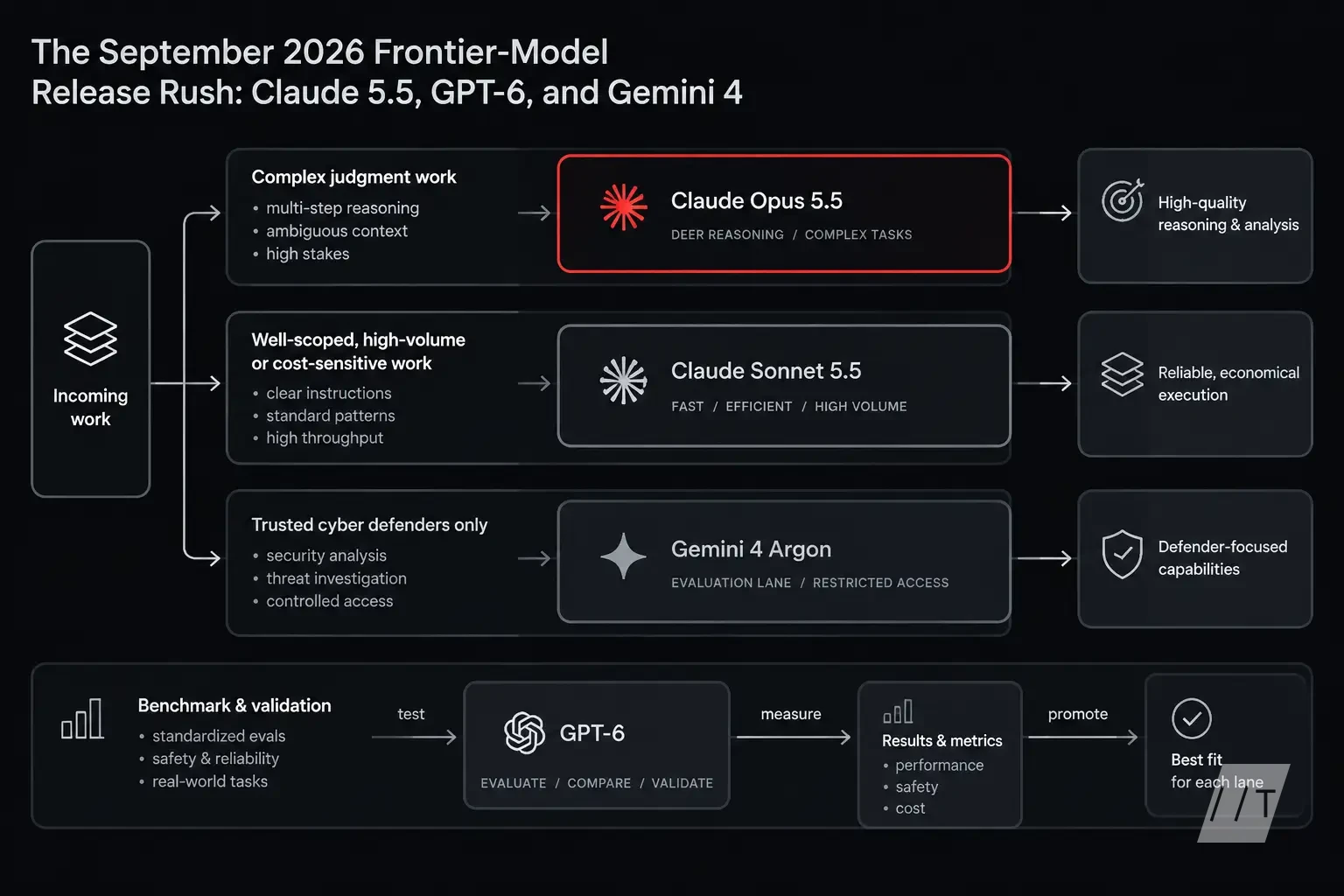
Anthropic’s Claude 5.5 lineup is positioned as a division of labor, not a single replacement model. Claude Opus 5.5 targets complex work where careful judgment matters. That makes it the candidate for ambiguous requirements, difficult analysis, and tasks where an incorrect decision costs more than additional inference time. No Opus benchmark or pricing detail is established here, so teams should not infer either from the family name.
Claude Sonnet 5.5 is the practical complement. Anthropic describes it as more than 30% faster than Sonnet 5 and up to 30% cheaper for most work. Its stated strengths are well-scoped everyday tasks, bug fixing, and polished documents, slides, and spreadsheets, including attention to design quality. Those claims point to a useful default for workloads that are repetitive, bounded, and volume-sensitive.
The routing implication is straightforward:
- Send judgment-heavy or high-consequence work to Opus when quality justifies the cost and latency.
- Send clearly specified coding tasks, routine transformations, document generation, and office workflows to Sonnet 5.5.
- Use Sonnet’s speed and lower price to support higher-throughput applications, but validate the claimed gains on your own prompt mix. “Up to 30%” is not a guaranteed reduction for every request.
This split also argues against using Opus as a universal default. A cheaper, faster model that handles a defined task reliably will usually produce better system economics, even if Opus is stronger on difficult cases. Conversely, routing ambiguous work to Sonnet solely because it is cheaper can move costs into review, retries, and failures.
Anthropic also mentions a Claude Haiku 5.5 model, but provides no usable detail in the confirmed positioning here. It should not be assigned a role or performance expectation until its capabilities, pricing, and availability are specified.
GPT-6: Separate the names from the evidence
The GPT-6 record is currently too fragmented to support broad product conclusions. A release tracker lists GPT-6 Luna on September 22. Separately, the LiveBench Reasoning leaderboard records GPT-6 Astra at 92.7% as of September 19. These are different model names, and the leaderboard date predates the Luna listing. Neither detail establishes that the other model is publicly available, part of the same selectable family, or representative of all GPT-6 variants.
The leaderboard result is useful as a signal, not a product specification. It does not reveal GPT-6’s complete capability range, pricing, context limits, tool behavior, or deployment requirements. It also cannot establish that a model listed as Luna performs like Astra. Treating the two fragments as a complete GPT-6 launch story would turn an identifier and a benchmark score into assumptions about an API product.
Before adoption, verify the operational facts directly:
- Is the target model available through the API, and under what access terms?
- What latency and rate limits should production workloads expect?
- What context limits, input modalities, and output constraints apply?
- How do tool calls, structured outputs, streaming, and retries behave?
- What are the observed error and refusal modes on representative tasks?
- What is the fully loaded cost, including input, output, caching, and tool usage?
Until those questions have answers, GPT-6 Astra’s score belongs in the validation queue, while GPT-6 Luna’s listing belongs in the availability check. Teams should test the exact endpoint and configuration they intend to deploy rather than infer a family-wide capability or pricing picture from either fragment.
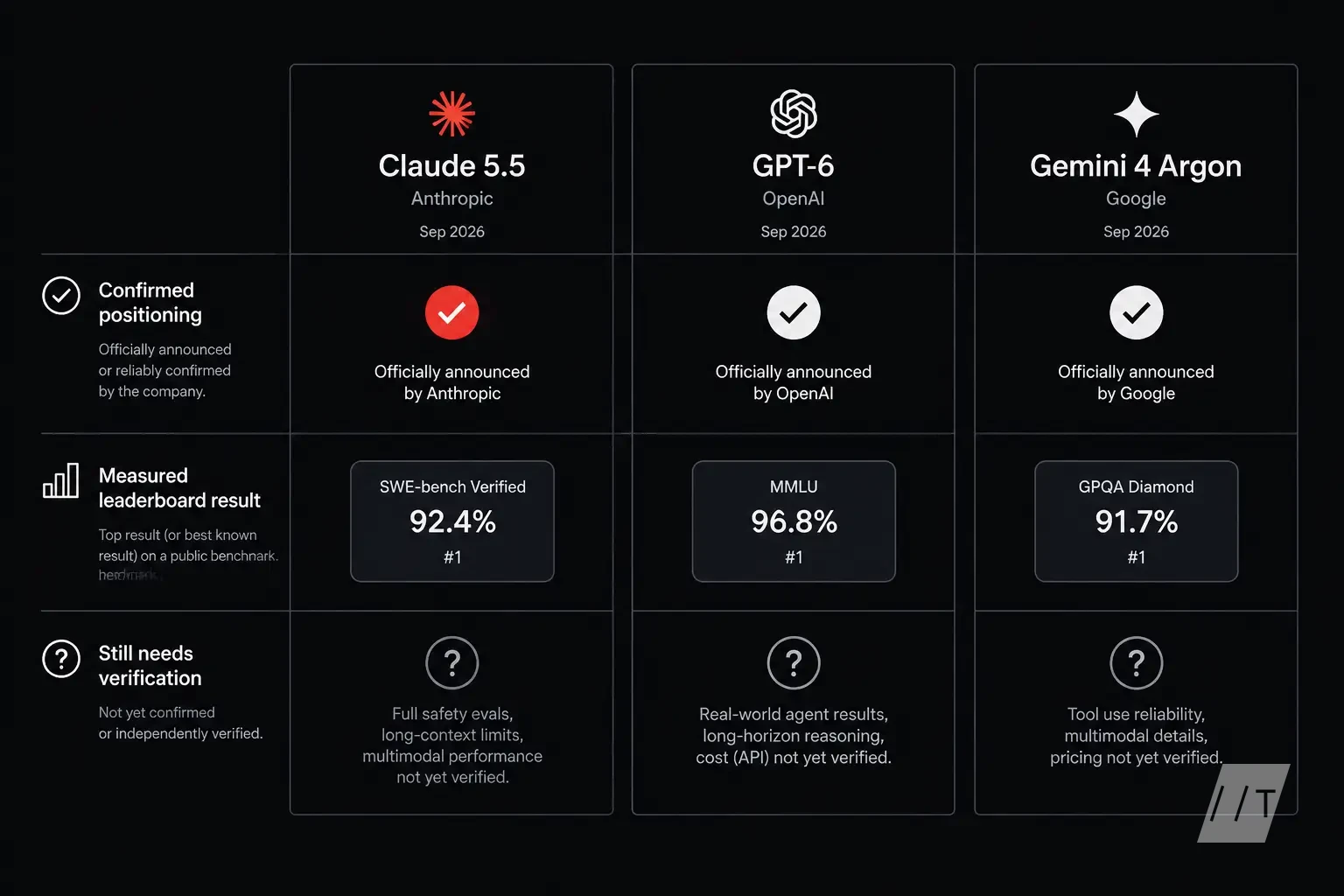
LiveBench’s September 19 snapshot puts GPT-6 Astra first in its reasoning category at 92.7%, ahead of Claude Fable 5.1 at 91.7%, among 56 model configurations with published results. That is useful evidence, but only for the question the benchmark asks.
It is not a universal model ranking. LiveBench Reasoning measures a particular class of tasks, including logic and spatial problems and variants of classic riddles. A lead there does not establish better software engineering, document generation, retrieval, tool use, or production reliability. It also does not compare identical deployment conditions by default: model configuration, prompting, system instructions, tool access, and evaluation date can affect results.
Freshness matters too. A leaderboard dated September 19 can become stale quickly during a release cycle. The score should be treated as a snapshot for forming evaluation hypotheses, not as a deployment decision.
Teams should validate the workloads they actually run. Measure task quality on representative prompts, then add operational metrics: latency at the required percentile, total cost per successful task, timeout and refusal rates, recovery from malformed tool calls, and failure modes under long context or multi-step execution. Tool-use performance deserves separate testing; reasoning scores do not predict whether an agent reliably selects the right tool, passes valid arguments, or recovers when a call fails.
GPT-6 Astra’s result is therefore a strong signal to test, not proof that every GPT-6 variant—or GPT-6 as a family—is the best production choice. The benchmark narrows what to investigate. Your workload and operating constraints decide what ships.
Gemini 4 Argon: announced, not broadly selectable
Google announced Gemini 4 Argon on September 30, positioning it as a frontier model for complex workflows across three areas: software engineering, enterprise knowledge work such as legal and finance, and cybersecurity defense.
That positioning is broad, but its access posture is narrow. Argon was rolling out to a set of trusted cyber defenders through Google’s stated program. The announcement therefore establishes intended use cases and an access path—not general availability for arbitrary production workloads.
That distinction changes how teams should evaluate it. A model can sound relevant to a legal-review pipeline or a security-operations workflow without being available through the API, region, contract, or data controls that pipeline requires. Limited rollout also restricts reproducibility: most teams cannot yet run their own representative prompts, tool calls, latency tests, or failure analysis.
Treat Argon as a restricted evaluation candidate, not a default option in a model router. Confirm who can access it, which interfaces and quotas apply, what data-handling terms govern use, and whether the available workflow matches production requirements. If those conditions are not met, the announcement is useful market intelligence but not an actionable deployment choice.
For teams with legitimate access, start with the workflows Google emphasizes and compare Argon against the model already in production. Measure task completion, correction rate, tool-use reliability, latency, and total cost. Until access broadens and those measurements are available, “frontier performance” remains a product claim to test—not a reason to redesign a production stack.
A practical selection playbook
Start with workload slices, not model names. Separate software changes, document generation, extraction, customer support, agentic tool use, and high-stakes judgment. For each slice, define an acceptance test with representative prompts, realistic context, required tools, and known failure cases. A model that wins on isolated prompts but mishandles your tools or data is not the better production choice.
Run the same evaluation set across candidates, then measure four things together: task quality, end-to-end latency, total cost, and failure rate. Include retries, tool calls, orchestration, and human review in the cost calculation. Test safety behavior, data-retention and access controls, regional availability, and logging requirements. Finally, simulate fallback: rate limits, timeouts, malformed tool calls, degraded providers, and model refusal. Reliability under failure is part of model quality.
Use the decision rule that matches the operational constraint:
- Availability and predictability dominate: keep an established model with stable API access, known limits, and dependable support. A modest quality gap rarely justifies operational uncertainty.
- Scoped, high-volume, cost-sensitive work: trial Claude Sonnet 5.5. Its stated speed and cost improvements over Sonnet 5 make it a sensible candidate for bug fixing, routine transformations, and polished office artifacts—but verify those gains on your traffic.
- Judgment-heavy work: evaluate Claude Opus 5.5 where ambiguity, planning, or consequential decisions matter. Route only workloads that can justify its likely higher resource cost.
- GPT-6: treat the reported results as validation inputs, not a deployment decision. Verify the exact model, API availability, context limits, tool behavior, latency, pricing, and reliability before assigning production traffic.
- Gemini 4 Argon: evaluate it only when access is available and its workflow fit is real. A restricted rollout cannot serve as a general replacement strategy.
Promote a model only after it passes quality, cost, latency, governance, and fallback tests on representative workloads. Keep routing granular: one provider need not win every slice.
September’s release rush expands the frontier faster than it resolves model choice. Product positioning, benchmark performance, and deployable access are separate facts: Claude Opus 5.5 may fit judgment-heavy work; Sonnet 5.5 targets faster, cheaper scoped execution; GPT-6’s leaderboard signal remains a validation input, not a complete product assessment; and Gemini 4 Argon is constrained by its trusted-defender rollout.
A leaderboard result cannot answer whether a model is available through your API, reliable under your workload, or economical after retries and tool calls. An announcement cannot establish production readiness. Selection still requires representative evaluation.
For the next cycle, verify:
- Availability: Can the team actually access and provision the model?
- Task quality: Does it solve your workload, including tool use?
- Total cost: What do tokens, retries, and orchestration cost?
- Latency: Does it meet interactive or batch targets?
- Reliability: How often does it fail, drift, or require intervention?
- Governance: Are data controls, safety, and audit requirements met?
- Rollback: Can traffic return safely to a known model?
Choose the model that clears those tests—not the one that wins a snapshot.