
Kolibri’s 1M-token context window is the headline feature. It is also the least sufficient definition of sovereignty. Sovereign deployment depends on how the model’s architecture, license, weights, and operating environment fit together—and on who can control each of them after launch.
Aleph Alpha describes Kolibri as an English-German mixture-of-experts Transformer with 78 billion total parameters and roughly 3 billion active for each token. The full weights are downloadable, and the model is released under Apache 2.0. Those choices matter: they create a path away from a provider-only API and permit broad commercial integration. They do not, by themselves, guarantee independent inference, auditable updates, or durable control of the service.
The relevant question is therefore not simply whether Kolibri can process a million tokens. It is whether an organization can lawfully obtain the model, run it inside its own jurisdiction, govern its artifacts and data, and keep the resulting system operational over time.
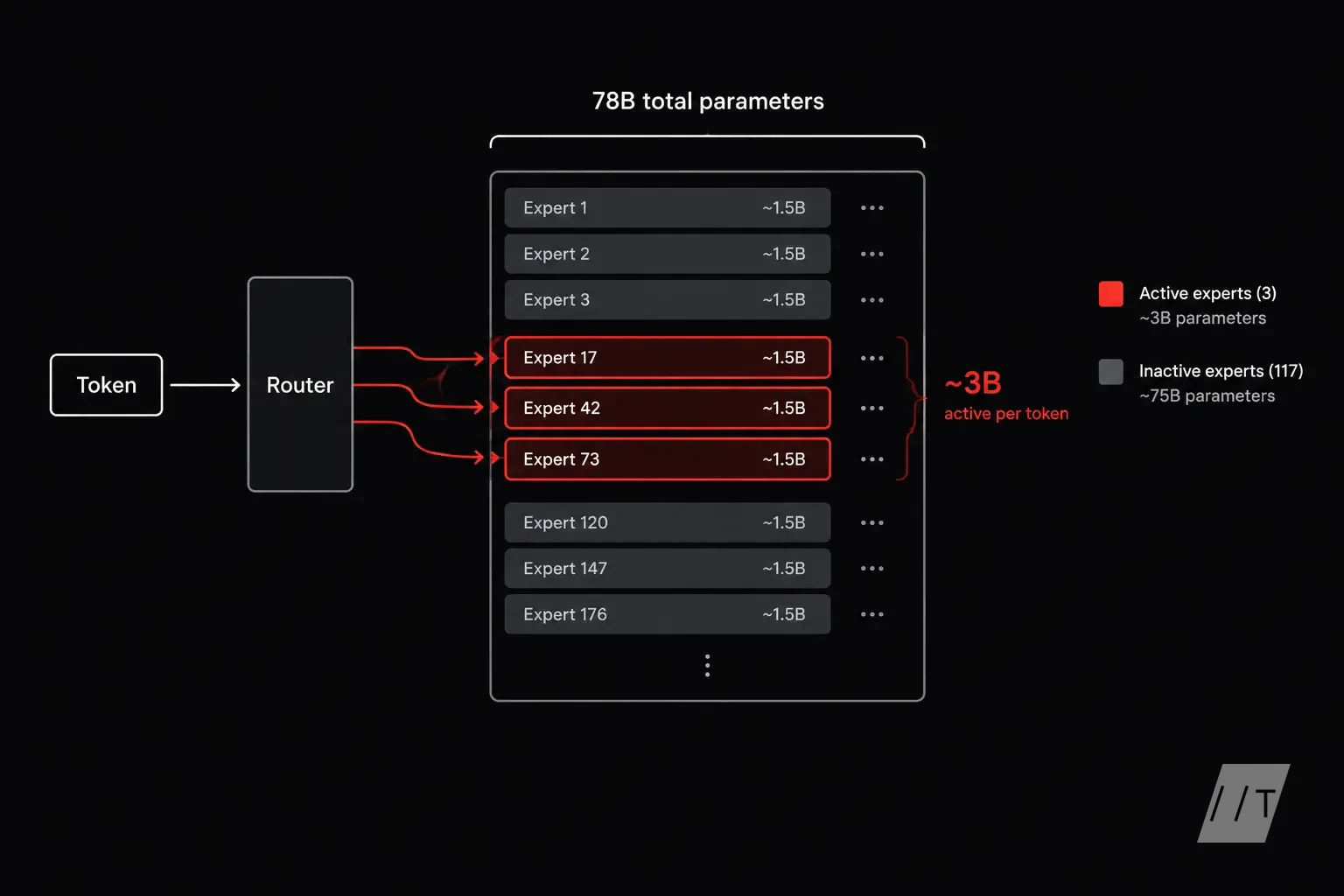
Kolibri’s headline is 78B parameters, but that is not the amount of model computation applied to every token. Its sparse mixture-of-experts (MoE) design routes each token through only a selected subset of experts, with roughly 3B parameters active at a time. The remaining parameters are available in the model, but are not simultaneously evaluated for each token.
That distinction changes the deployment calculation. Dense 78B inference would require substantial compute for every generated token. Sparse routing can deliver a larger total capacity while keeping per-token arithmetic closer to a much smaller model. In practice, that can improve throughput, reduce compute cost, and make local or dedicated deployment more plausible than the headline parameter count suggests.
It does not make Kolibri a 3B model. The full weight set still has to be stored, loaded, and made available to the serving system. Depending on quantization, batching, concurrency, and the runtime, that can require significant GPU memory, CPU memory, fast storage, and interconnect bandwidth. Routing also introduces serving complexity: the system must select experts efficiently and avoid uneven load that leaves hardware underused.
The useful metric is therefore not just total parameters or active parameters, but the complete operating footprint. Per-token sparsity can lower compute demand; it does not eliminate memory capacity, cooling, networking, orchestration, monitoring, or maintenance. A local deployment still needs compatible inference software, hardware procurement, performance tuning, security controls, and an operator responsible for keeping the service reliable.
MoE makes Kolibri more feasible to run than a dense model with the same total parameter count. It does not make sovereignty—or infrastructure—free.
A Million Tokens Is Capability, Not Control
A 1M-token context window changes what a single inference can consume. Kolibri can potentially process large document collections, extended case records, or long-running project histories without repeatedly splitting them into fragments. That can reduce truncation and some external retrieval steps, preserving relationships that are easy to lose when a system retrieves only small passages.
It also creates costs. Long contexts increase memory pressure, often increase latency, and complicate batching and concurrency. The advertised limit is not the same as uniformly reliable use at that limit: organizations still need evaluations for retrieval quality, instruction following, omissions, and performance across different document layouts and languages. Large inputs also expand data-handling risk. More sensitive material can enter one request, making access controls, logging, retention, and isolation more consequential.
Most importantly, context capacity says nothing by itself about who controls inference. A hosted endpoint may offer a 1M-token window while retaining control over the hardware, runtime, telemetry, model version, and update schedule. Customers gain access to a capability, not necessarily the ability to inspect or operate the system independently.
Kolibri’s long context is therefore useful infrastructure for sovereign deployments, especially where documents should remain inside an organizational or national boundary. But sovereignty requires control of the complete inference path: the weights, serving stack, data flows, hardware, updates, and operational decisions. A million-token request sent to someone else’s service remains someone else’s computation.
Local weights are the first sovereignty layer
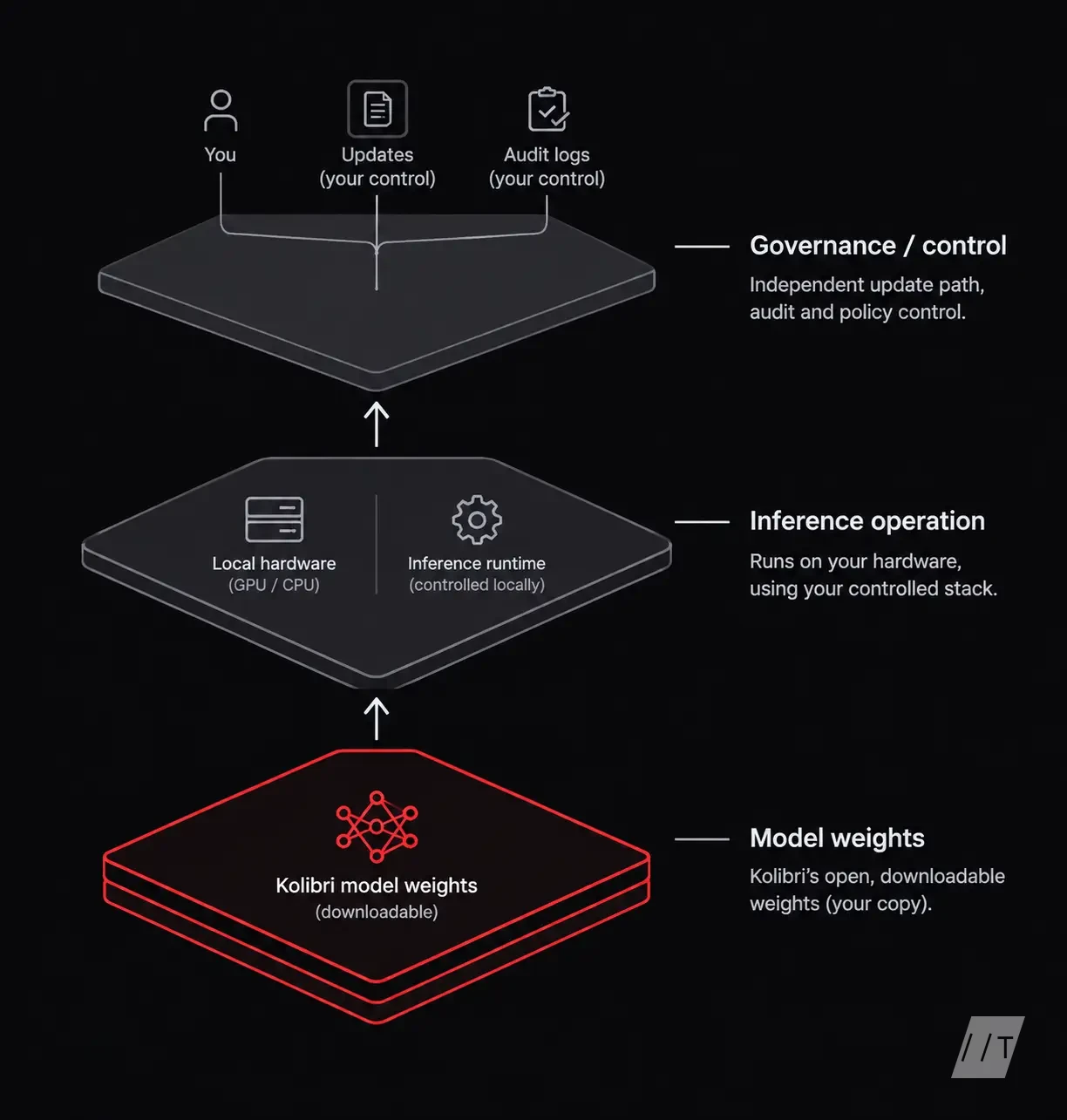
A model cannot be sovereign if access to it ends at someone else’s API. Kolibri’s full downloadable weights change that dependency. An organization can retain the model artifacts, run inference inside its own environment, and avoid sending prompts and outputs to a provider-controlled service. For regulated workloads, that preserves the option of keeping execution within the relevant jurisdiction rather than treating data residency as a promise made by an external platform.
Weight access also creates technical room that an API does not. Teams can inspect the released artifacts, adapt the model to local requirements, integrate it with their own serving stack, and maintain a known version after a provider changes or retires a hosted endpoint. They can evaluate behavior against internal data without exposing that data during every test. Those are practical capabilities, not semantic distinctions.
But possession is only an enabling condition. The weights still have to be stored, loaded, served, secured, and monitored. An organization needs suitable hardware, an inference implementation, operators, and a plan for vulnerabilities, upgrades, and failures. It must also verify what was downloaded and establish that its deployment remains inside the intended legal and territorial boundary.
“Open-weight” therefore describes an important transfer of control, not a completed sovereignty claim. Kolibri’s downloadable weights remove one major external dependency. They do not remove the infrastructure, governance, or maintenance required to operate the model independently.
Apache 2.0 supplies the legal complement to downloadable weights. It generally permits commercial use, modification, redistribution, and integration into proprietary or internal systems, subject to its notice, attribution, and patent provisions. That removes a major restriction: an organization can adapt Kolibri, package it with its own serving stack, and distribute a modified system without negotiating a new model-specific commercial license.
Those rights are not the same as sovereignty. Apache 2.0 governs the licensed material, not every dependency required to operate it. A deployment may still rely on serving software, tokenizer components, datasets, container images, cloud infrastructure, or hardware controlled by other parties. Their licenses and supply chains can impose separate constraints. Data provenance matters too: permission to run the model does not make training data, prompts, or generated outputs automatically lawful to use.
Update control is another boundary. A permissive license allows an organization to pin a version, fork it, and maintain an internal release path. It does not guarantee that future weights, security fixes, or compatible tooling will arrive, nor does it eliminate obligations introduced by later additions. Jurisdiction also remains operational and legal: who can access the machines, where inference occurs, and which courts or suppliers ultimately govern the stack.
“Open-weight” and “open-source” should therefore remain distinct labels. Open weights describe access to model parameters. Open-source, when used precisely, implies broader inspectability and licensing of the relevant code and artifacts. Kolibri’s Apache 2.0 weight release is a strong legal starting point, but sovereignty depends on what an organization can actually inspect, control, and sustain around those weights.
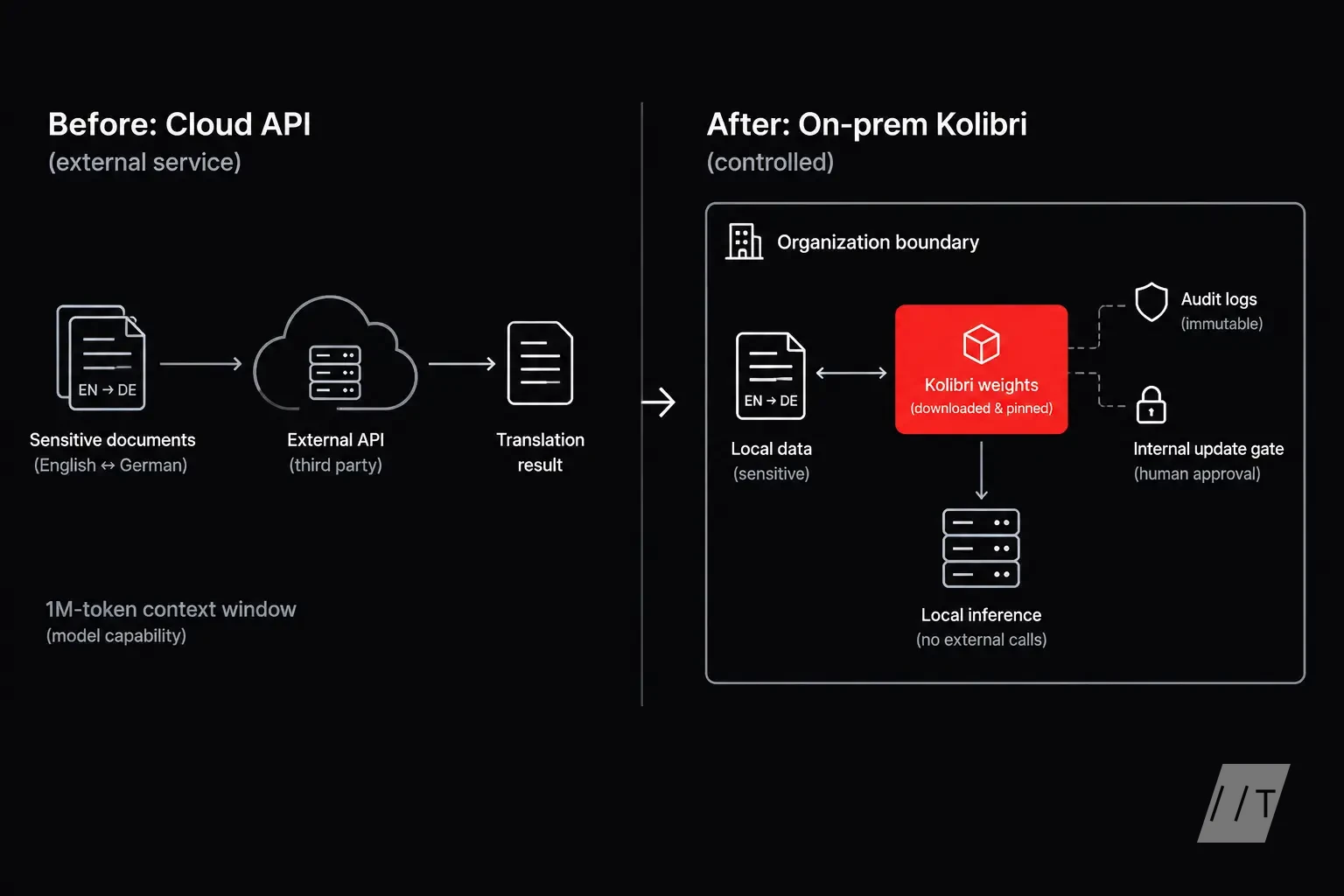
The deployment test is simple: can an organization run Kolibri without sending prompts to an external service? Downloadable weights and Apache 2.0 make that legally and technically possible. They do not make it operationally automatic.
A serious deployment must pin a specific model artifact, verify its provenance, and record which tokenizer, runtime, routing configuration, and optimization libraries produced each result. Updates should pass through an internal review gate, not arrive implicitly through a hosted endpoint. Logs, access controls, encryption, retention policies, and network isolation determine whether sensitive English-German documents actually remain inside the organization’s boundary.
Kolibri’s sparse MoE design helps with serving economics. Roughly 3B parameters are active for each token, so compute per token can be far below what a dense 78B model would require. That improves the case for local inference and can reduce ongoing accelerator cost. It does not eliminate the need to store and load the full 78B weight set, nor does it make routing, parallelism, failover, observability, or capacity planning trivial.
The 1M-token context limit adds another constraint. Long inputs require substantial key-value-cache memory, and memory pressure grows with sequence length, concurrency, and precision. Latency and throughput can degrade before the advertised limit becomes useful. Evaluation is also harder: organizations need tests for retrieval across long documents, truncation behavior, prompt injection, and failure under sustained load.
The cost calculation therefore includes hardware, power, serving software, security engineering, version audits, and staff who can maintain the system. MoE reduces per-token work; it does not remove the fixed cost of owning a large model or the resilience work required to keep it available. Sovereignty is credible only when the organization can operate that stack reliably, not merely download it.
A practical sovereignty checklist
Before calling a Kolibri deployment sovereign, verify five layers:
- Technological control: Can the organization obtain and run the complete weights, inspect the artifacts, and choose its inference stack?
- Legal freedom: Do the Apache 2.0 terms cover the intended commercial use, modification, redistribution, and integration? Are model, data, and dependency obligations documented?
- Operational independence: Can teams serve requests without a provider API, protect prompts and outputs, pin versions, and retain audit logs?
- Territorial execution: Does inference run within the required jurisdiction, on hardware and networks the organization can govern?
- Continuity: Is there a tested update, rollback, patching, and maintenance process, with enough engineering capacity to keep the service dependable?
Kolibri’s downloadable weights and Apache 2.0 license make these questions actionable. Its sparse design can improve serving economics, but the 78B weight set, long-context memory requirements, hardware supply, and ongoing operations still impose real constraints. The 1M-token window is valuable infrastructure: it can reduce truncation and external retrieval for large working sets. It is not a sovereignty guarantee.
The story is complete only when an organization can lawfully obtain the weights, run them under its control, keep sensitive data inside its boundary, inspect and govern changes, and sustain the service when the original provider is unavailable.