
TechCrunch reports that Hugging Face is reportedly in talks to be acquired for $13 billion. That is a report about ongoing discussions, not a completed transaction: no deal, valuation, or buyer should be treated as settled.
The figure still raises a useful strategic question. Why would a company that does not primarily train frontier foundation models—and is not itself an end-user application—command this level of attention? Hugging Face sits between those two groups. It helps developers find, share, evaluate, and use models, datasets, and related tools. That position can make it more than a repository or community site. It can become part of the workflow through which AI products are built. If the reported talks prove meaningful, the broader signal is that control of this developer-facing layer may matter nearly as much as ownership of individual models.
Hugging Face occupies the layer between foundation-model builders and application teams. It is not primarily where large models are trained from scratch, nor is it the end-user product built on top of them. It is the shared developer environment where models, datasets, libraries, evaluation tools, and technical communities meet.
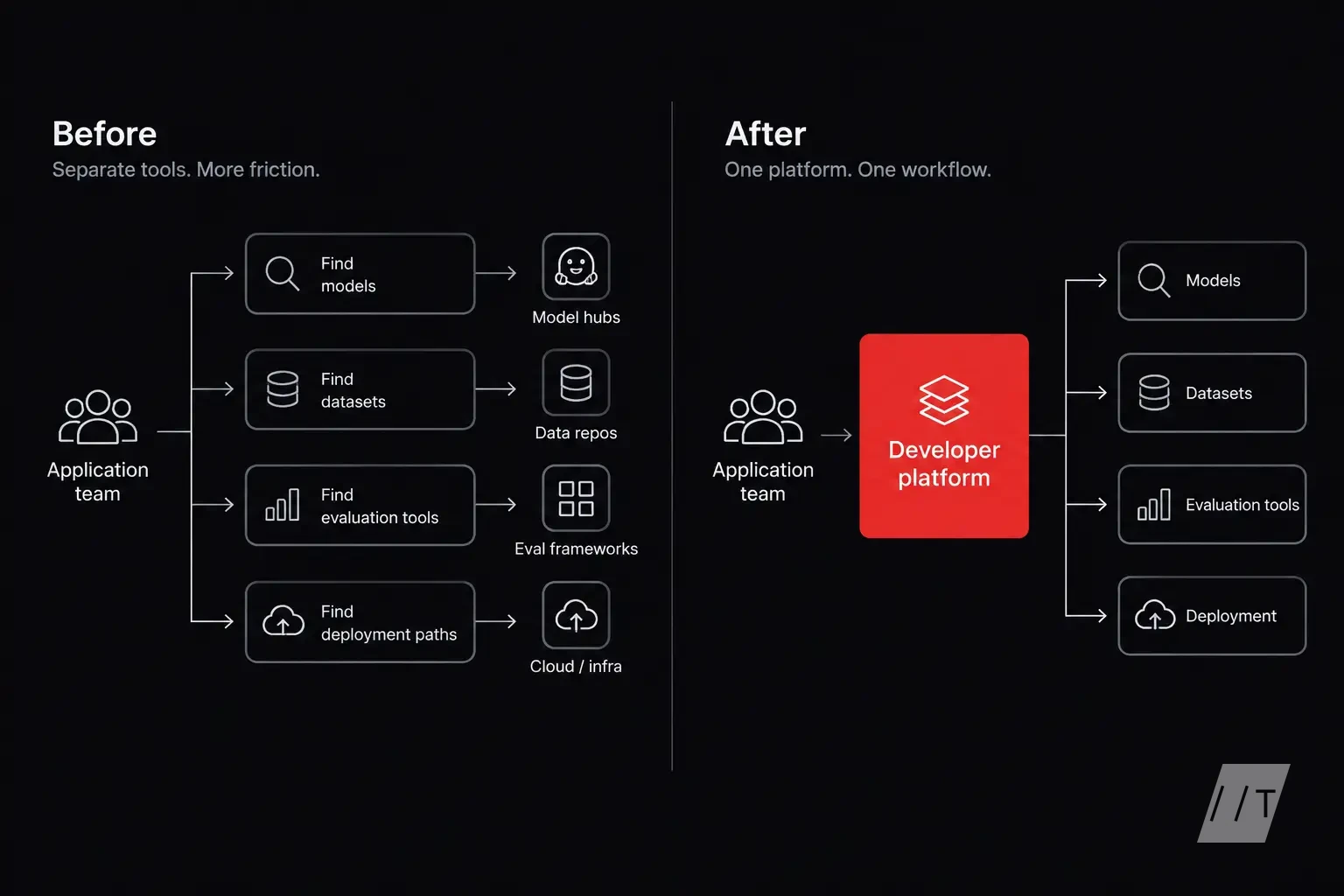
That position matters because AI development is rarely just a matter of selecting a model and calling an API. Teams need to find candidates, inspect licenses and capabilities, test them against relevant data, compare results, adapt models, and decide how to deploy them. A platform that brings these steps closer together can reduce the operational and search costs around each project.
The catalog is only part of the value. Model repositories, dataset documentation, example code, benchmarks, discussion threads, and contributor activity provide context that standalone model endpoints often lack. They help developers understand not only what a model claims to do, but how others are using it and where it fails.
This layer also remains comparatively model-agnostic. A developer platform can support models from multiple labs, open-source projects, and private contributors rather than tying users to one training organization. That makes it different from a foundation-model company competing on scale, compute, and model quality. It is closer to shared infrastructure for choosing and working with those models—an organizing layer that can make a fragmented AI ecosystem easier to navigate.
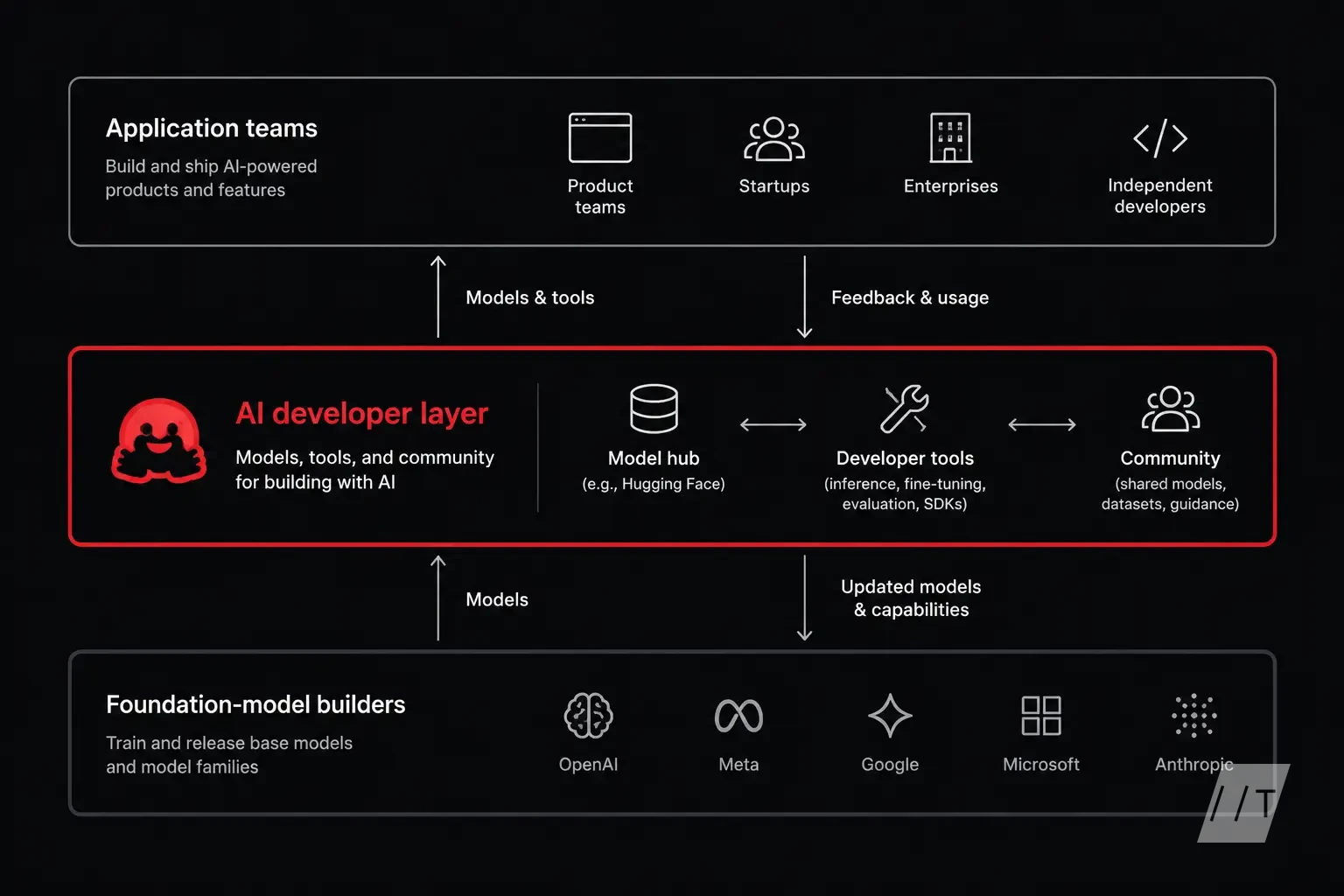
The strategic value of this middle layer is not just that it hosts artifacts. It can organize the workflow around them.
A developer may discover a model, compare its evaluations, inspect licensing and usage constraints, test it against a dataset, adapt it, and move it toward deployment. If those steps happen through connected tools, the platform becomes a recurring control point rather than a one-time catalog. Each interaction can reduce search costs and make the next project faster: reusable datasets, model configurations, evaluation scripts, inference endpoints, and integration patterns become building blocks instead of isolated experiments.
That position matters because AI development is rarely a single-model decision. Teams may compare models from several vendors, combine open and proprietary components, or replace a model as price, quality, latency, or licensing changes. A developer layer that remains useful across those substitutions can capture workflow value without owning the underlying model.
Ownership of discovery and evaluation also shapes what gets attention. Search results, benchmarks, usage patterns, documentation, and community feedback influence which models developers try and which components become standard practice. Deployment integrations extend that influence from experimentation into production, where switching costs and operational context are higher.
The advantage is practical, not magical. A platform must keep evaluations credible, metadata current, licenses clear, and tools reliable. It also has to support competing providers without making the ecosystem feel captive. If developers view it as neutral, useful infrastructure, repeated engagement can compound. If it becomes slow, restrictive, or biased toward one vendor, teams can route around it.
Network effects are plausible here, but they are not automatic. More contributors can publish more models, datasets, and tooling. That gives researchers and application developers more material to test. Their usage can generate feedback, benchmarks, integrations, and documentation that make the platform more useful to model creators and dataset publishers in return.
The reinforcing loop involves several distinct groups:
- Model creators gain distribution and practical feedback.
- Dataset publishers gain visibility and downstream users.
- Researchers gain shared artifacts and reproducible experiments.
- Application developers gain components they can evaluate and adapt.
- Contributors gain collaborators, users, and signals about what works.
That activity can make a platform harder to ignore. It does not make it impossible to replace.
Popularity is not the same as defensibility. Developers may mirror repositories, move to cheaper infrastructure, or use open tooling directly. Model creators can publish across several channels. A large user base may also be expensive to serve and difficult to convert into predictable revenue, particularly when much of the ecosystem is open.
The key question is whether participation creates durable dependencies: trusted evaluation history, useful workflow integrations, proprietary operational data, or collaboration patterns that users would lose by leaving. Without those, network effects may produce attention rather than control. An active community can still coexist with weak monetization, fragmented usage, and intense competition from cloud providers, model vendors, and specialized tools.
An acquirer could value Hugging Face for reach more than for any single product. A platform used by model creators, researchers, and application developers provides repeated access to the people deciding which models and tools enter production. That distribution can be strategically useful even when users are not locked into one vendor’s model family.
Technical talent is another possible asset. Operating a large model-and-dataset ecosystem requires expertise in machine learning, infrastructure, developer tooling, and open-source collaboration. An acquisition could give the buyer a team that understands how research artifacts become usable components, though talent retention would be a material risk rather than an automatic benefit.
The platform may also generate ecosystem signals: which models are downloaded, evaluated, adapted, discussed, or embedded in applications. Such activity is not the same as proprietary training data, and popularity is not proof of quality. But aggregated usage patterns could help an acquirer identify demand, emerging technical directions, and points of friction in AI workflows.
Distribution is the broader prize. A buyer could place its services closer to model discovery, evaluation, fine-tuning, deployment, and collaboration—the decisions that shape how developers build. Hugging Face’s support for multiple model providers could also offer strategic positioning across a fragmented market, rather than tying the buyer to one laboratory.
These are possible sources of value, not confirmed deal terms or stated motives. The reported $13 billion figure reflects a reported acquisition conversation, not a completed transaction or an independently established valuation.
The Middle Layer Has Real Limits
The strategic case is not guaranteed. Cloud platforms can bundle model catalogs, training tools, deployment, and billing into existing workflows. Model vendors can make their own ecosystems sticky, while open-source projects and specialized infrastructure providers can offer narrower tools that are cheaper or better for a specific job. A central platform must keep earning its place.
Monetizing an open ecosystem is also difficult. Users may generate substantial activity without paying, and commercial features can create tension with the neutrality and accessibility that attracted the community. Revenue from hosting, inference, enterprise controls, or support may not scale in proportion to usage.
Governance is a further constraint. Model licenses, dataset provenance, safety practices, moderation, and security all affect whether organizations trust the platform for production work. A widely used repository becomes a high-value target for abuse and supply-chain failures.
Finally, developers can switch tools, mirror assets, use direct model APIs, or assemble workflows from independent components. Network effects help only when the platform delivers enough convenience, trust, and technical value to outweigh that portability. Popularity is an asset; it is not permanent control.
If TechCrunch’s report proves meaningful, the signal extends beyond Hugging Face. AI-market value may accrue not only to companies training foundation models, but also to the infrastructure and communities that determine how those models are discovered, evaluated, adapted, and deployed. That layer can influence developer behavior across competing model providers, making it strategically important even without owning the underlying models.
The reported $13 billion acquisition talks are not a completed transaction, and the figure should not be treated as a confirmed valuation or deal rationale. Still, the report highlights a broader shift: developer workflows are becoming part of the AI platform battle. The durable winners may include companies that reduce the operational friction between model supply and application demand—provided they can convert ecosystem activity into trusted, defensible, and sustainable products.