
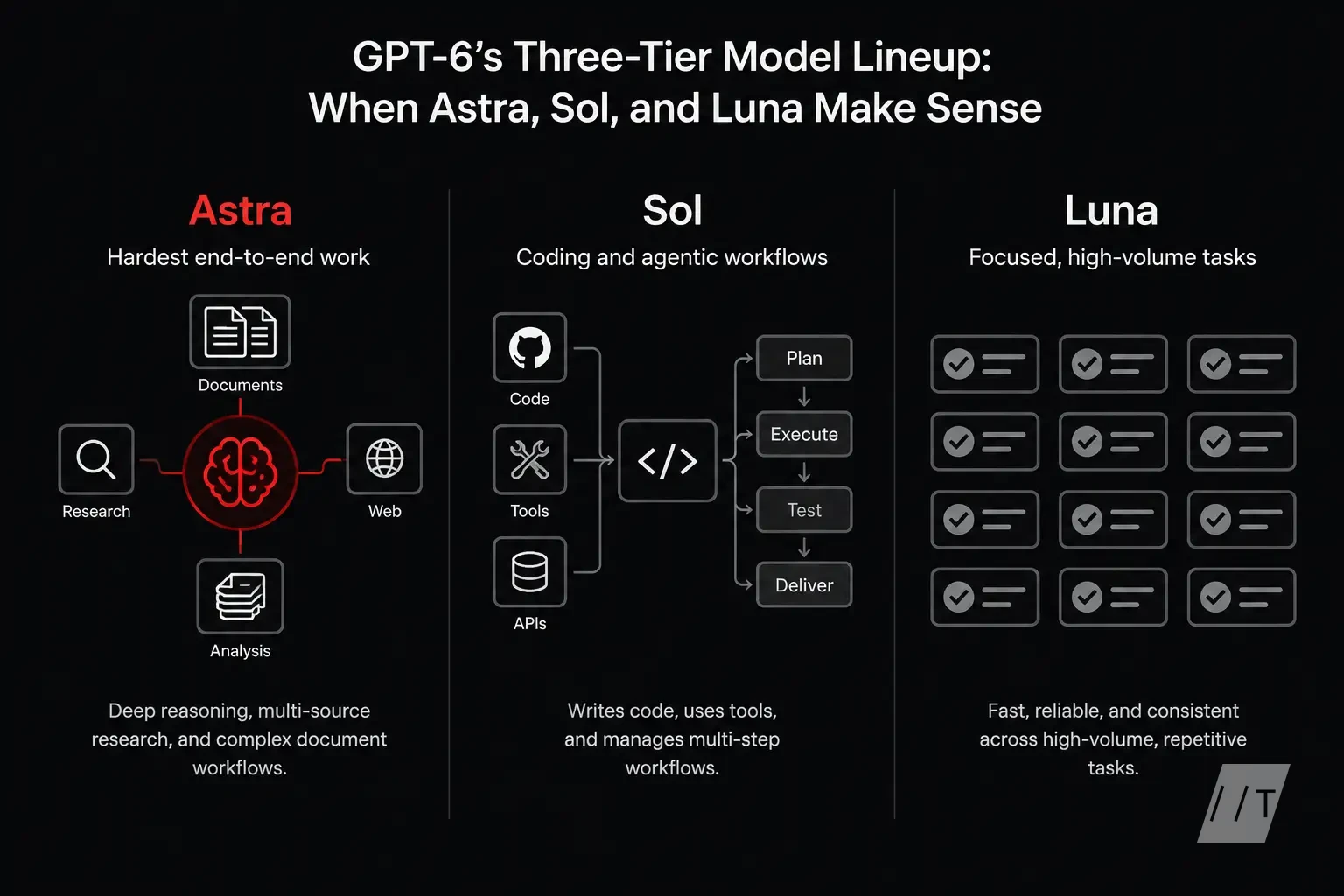
GPT-6 model selection is an architecture and budget decision, not a simple quality ranking. Astra, Sol, and Luna occupy different operating points: Astra handles the hardest end-to-end work, Sol targets coding and agentic workflows, and Luna is optimized for focused, high-volume tasks.
The practical choice depends on task complexity, request volume, tool requirements, failure cost, and latency—not just benchmark scores or token price. A routing strategy may use all three: Luna for routine traffic, Sol for iterative software and tool workflows, and Astra for difficult exceptions.
Their baseline interface capabilities are shared. All three accept text and image input, produce text output, support multilingual use and vision, and are available through the Responses API and client SDKs. The differences emerge in model specialization, reasoning controls, pricing, and operational constraints. Engineers should select the tier that fits the workload, then validate that choice against production-like quality, cost, and reliability measurements.
Astra: Maximum Capability for Hard Problems
GPT-6 Astra is the flagship model for the hardest end-to-end work. Its model ID is gpt-6, and it is designed for complex reasoning, coding, computer use, research, and document creation—not just short-form answer generation.
Astra exposes five reasoning-effort levels: low, medium, high, xhigh, and max. That gives teams a direct control over the quality–latency–cost tradeoff. Lower effort can serve routine requests; higher settings are appropriate when the model must plan across many constraints, inspect evidence, operate software, or produce a reliable artifact.
Its 1,050,000-token context window and 128,000-token maximum output support large repositories, long documents, extensive research material, and multi-step workflows in one interaction. The listed knowledge cutoff is April 30, 2026. Pricing is 50 per output million tokens.
That price is justified only when failure is expensive or the task spans several capabilities. Examples include debugging unfamiliar systems, synthesizing large technical or legal document sets, conducting open-ended research, generating production-grade documents, and computer-use workflows where a wrong action can create downstream work. Astra is also the sensible choice when the task boundary is unclear and forcing a cheaper model through repeated retries, escalation, or human review would cost more than the premium.
The shared context limit does not make Astra interchangeable with the other tiers. Its role is breadth and reliability on difficult work. For bounded transformations or routine volume, its capability is usually wasted; reserve it for requests where deeper reasoning materially changes the outcome.
Sol: The Agentic Middle Tier
GPT-6 Sol is the fast specialist for complex coding and agentic workflows. It supports six reasoning settings: none, low, medium, high, xhigh, and max. medium is the default. That range lets teams trade deliberation for latency and cost without switching models.
Sol provides a 1,050,000-token context window and a 128,000-token maximum output. Its knowledge cutoff is April 20, 2026. Pricing is 10 per million output tokens—materially below Astra, but high enough that unnecessary reasoning or verbose tool traces still matter at scale.
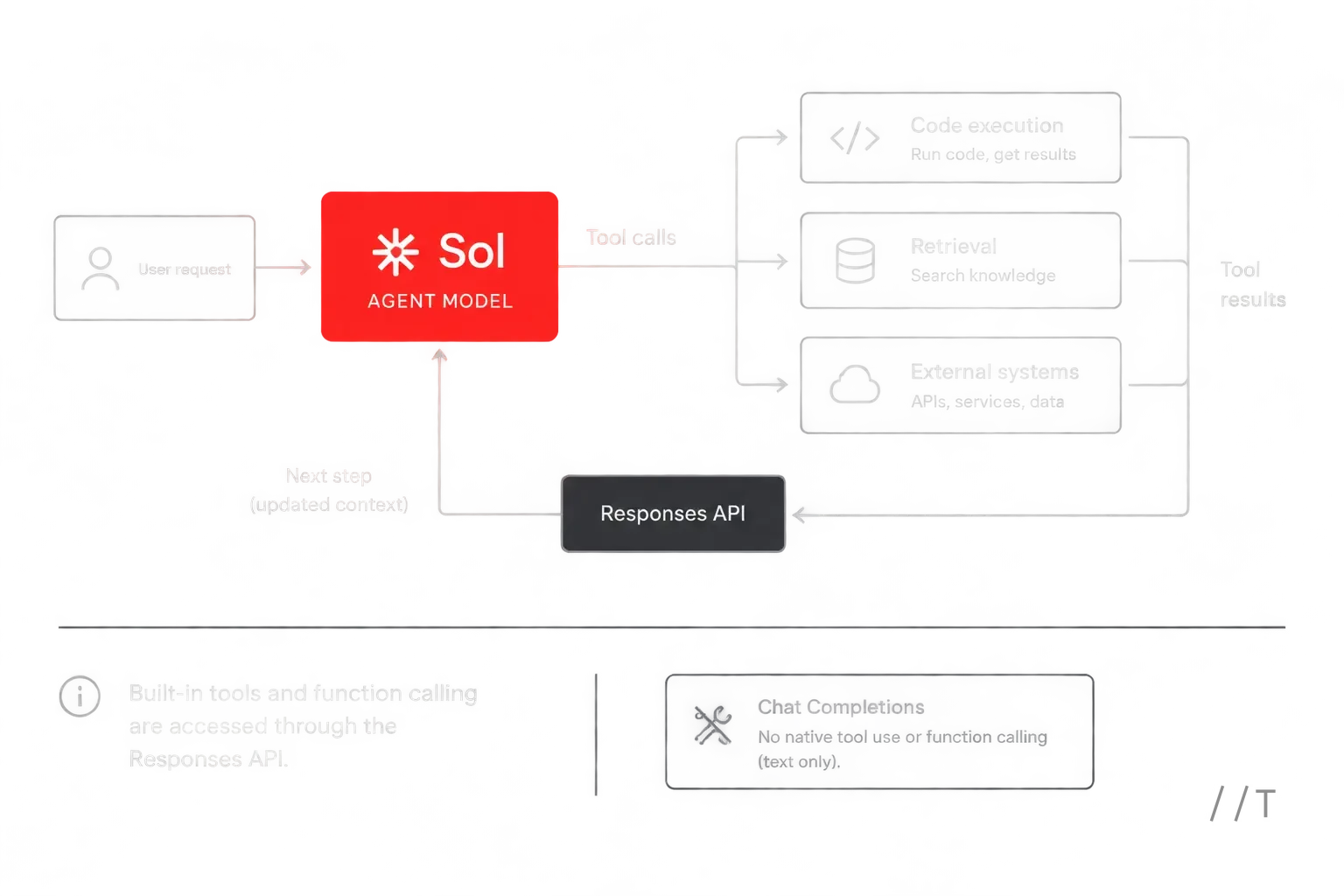
The Responses API is the practical default for Sol. It exposes built-in tools and function calling in the same interaction model, which suits agents that inspect a repository, call services, execute code, and iterate on results. Chat Completions has a narrower path: function calling is supported only when reasoning_effort is set to none. That limitation makes it a poor fit for reasoning-heavy tool loops, even when its simpler request format is otherwise convenient.
EU data residency is available only with Standard processing. Teams with residency requirements must verify that their processing configuration is eligible before designing Sol into a production workflow; model capability alone does not settle the deployment question.
Sol is therefore not simply a cheaper Astra. It is the better default when the work is software-centric, iterative, and tool-mediated. Use higher reasoning effort for difficult debugging or planning, and reserve none or lower settings for deterministic calls where agentic reasoning adds latency without improving the result.
Luna: Scale for Bounded Work
GPT-6 Luna is the economical tier for focused, high-volume tasks. Its 0.50 output pricing makes repeated inference inexpensive, but the savings depend on keeping the task boundary clear.
Luna supports reasoning.effort values from none through max, with medium as the default. That range lets you spend more inference on ambiguous cases, though bounded workloads usually need little reasoning. It has the same 1,050,000-token context window and 128,000-token maximum output as Astra and Sol. Those limits describe capacity, not equivalent capability: Luna is optimized for narrower operations. Its knowledge cutoff is May 18, 2026.
Good fits include classification, field extraction, transformation, summarization, routing, normalization, and other repeatable operations with explicit inputs and outputs. These workloads are easy to batch, evaluate, retry, and route by confidence. Luna is a poor default for open-ended investigation or tasks where a subtle failure creates expensive downstream work; the lower token price does not eliminate review and recovery costs.
Tool use follows Sol’s documented API constraints. Use the Responses API for built-in tools and function calling. Chat Completions supports function calling only when reasoning_effort is none. EU data residency is available only with Standard processing, so residency requirements must be checked before deployment rather than treated as a model-level assumption.
Cost and capability are separate axes
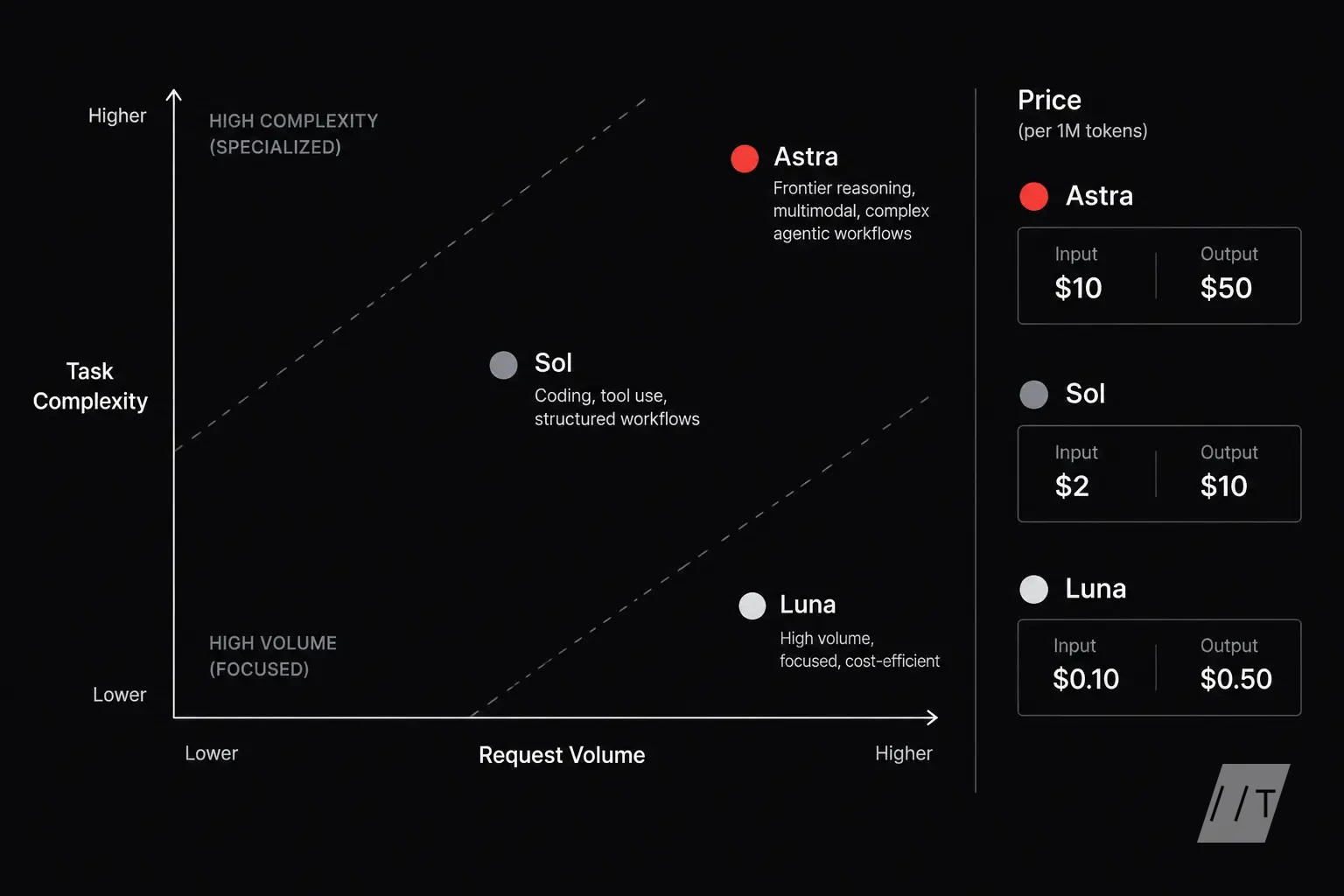
The listed input/output prices are:
- Astra: 50
- Sol: 10
- Luna: 0.50
All three list a 1,050,000-token context window and a 128,000-token maximum output. Those shared limits describe capacity, not behavior. They do not make the models interchangeable.
Astra’s premium buys the option to spend more reasoning on difficult, open-ended work. Sol costs one-fifth as much for input and output, making repeated coding and agent turns materially cheaper. Luna is another 20× cheaper than Sol and is the clear choice when a bounded operation runs at large volume.
Token price is only the first line item. Reasoning effort can increase work per request. Tool orchestration adds calls, latency, and state. A failed tool action may trigger retries or an escalation to a stronger model. Human review can dominate inference cost when the output affects customers, production systems, or regulated decisions. Conversely, a cheaper model that requires frequent correction is not cheaper in practice.
A useful comparison therefore includes:
Choose by workload economics: Luna for reliable, narrow repetition; Sol when tool-driven execution is central; Astra when failure or incomplete reasoning costs more than the price difference.
Choose Astra when the task is difficult, open-ended, multimodal, or expensive to get wrong. Its premium is justified when failure means incorrect research, flawed documents, or costly human rework.
Choose Sol when software engineering is the core problem: iterative coding, tool calls, workflow coordination, or an agent loop. It is the practical default when the model must act, inspect results, and continue rather than produce a single answer.
Choose Luna when the task is narrow, repeatable, and dominated by volume. Classification, extraction, transformation, and bounded summarization should start there unless production measurements show otherwise.
A useful router is hierarchical: send routine traffic to Luna, escalate ambiguous cases or tool-driven work to Sol, and reserve Astra for the hardest exceptions. Escalation rules should be explicit—confidence thresholds, schema failures, tool errors, or task complexity—not based on intuition at runtime.
Measure the router on representative production-like workloads. Track quality, latency, tool success rate, escalation rate, and total cost, including retries and human review. Benchmark rankings rarely predict those system-level costs; the best model is the one that meets the workload’s reliability target at acceptable end-to-end expense.
Use this checklist before shipping a router or production integration:
- Define the task boundary and what counts as failure.
- Estimate request volume, latency requirements, and the cost of a bad answer or retry.
- Set
reasoning.effortdeliberately; the default is not automatically optimal. - Use the Responses API when built-in tools or function calling drive the workflow; use Chat Completions only when its constraints fit.
- Verify EU data-residency eligibility, including the Standard-processing requirement for Sol and Luna.
- Test with production-like prompts, inputs, tool traces, and escalation paths.
GPT-6’s tiers are architectural components, not a leaderboard: Astra buys maximum capability, Sol specializes in agentic execution, and Luna provides economical scale.